Early access program
BeanFlux for coffee and cacao exporters
Starting December 2026, your buyer in the European Union can only file its due diligence statement (DDS) with the complete data for every order: the geolocation of every farm and the chain of custody of every lot. BeanFlux originates that data from the purchase and builds the EUDR dossier for every export order, checked before it leaves.
And with the private marketplace, your buying orders reach your entire supplier network without chats or calls. Quality after milling is already on the platform: preparations such as Supremo, EP and UGQ, cupping and samples. Shipments, packing and the FNC document chain we are building with a limited group of exporters, against their real operations.
Request early access →EUDR: traceability stops being a differentiator and becomes a requirement
The EU Deforestation Regulation (EUDR) covers coffee and cacao. To keep selling to European Union buyers, every exported lot will have to prove which farm it came from, with coordinates, and whose hands it passed through on the way to the container. Anyone who runs an exporter knows where the problem is: today that information lives scattered across buying-point spreadsheets, warehouse notebooks and people’s memory.
Farm geolocation
Every lot must be linked to the coordinates of the farm that produced it. If the purchase was recorded without that data, there is no serious way to add it six months later, once the lot has been milled and blended.
Chain of custody
Knowing the farm of origin is not enough. You must be able to prove the full journey: receipt, analysis, milling, blends, transfers between warehouses and assignment to the shipment. Every step, documented.
The data is born at purchase
Reconstructing traceability at export time is archaeology: cross-referencing sheets, calling suppliers, guessing. Originating the data at receipt, with the supplier standing in front of you, is just one more field. That is the whole difference.
What your buyer needs from you
Your buyer normally files the due diligence statement (DDS), and can only do it with the information on every farm and lot behind each order. If the data was originated properly, that package builds itself. If not, every order costs a week of work.
None of this is optional for anyone exporting to Europe. The only real decision is whether the data is originated properly at purchase, or reconstructed by hand before every shipment.
For the full detail on the regulation, dates and requirements, see the EUDR operational guide for coffee and cacao (in Spanish).
The dossier for every order, checked before it leaves
Your buyer normally files the DDS, and can only do it with the complete data for every order. BeanFlux consolidates into a single dossier the plots, producers, harvest dates and kilos behind every allocated lot, and checks it before it goes out. If something is missing, you see it first, not your buyer.
An export lot is usually a blend. The dossier resolves every origin that makes it up, not just the main one, through milling and blending.
- The plots behind every lot in the order, as GeoJSON, point or polygon
- Farms and producers of origin, with their harvest window
- Net kilos of the order, with the source stated: dispatch or allocation
- Operator, buyer with their country, and tariff code
- The path of every lot: receipts, transformations and allocation
- That every lot traces back to a receipt with registered origin
- That every geometry is valid, with a polygon when the plot exceeds 4 hectares
- That every plot has its 2020 cutoff attestation and every origin its harvest date
- That the order’s kilos are consistent with the kilos received from origin and the milling yield
- That the tariff code, the operator and the buyer are complete
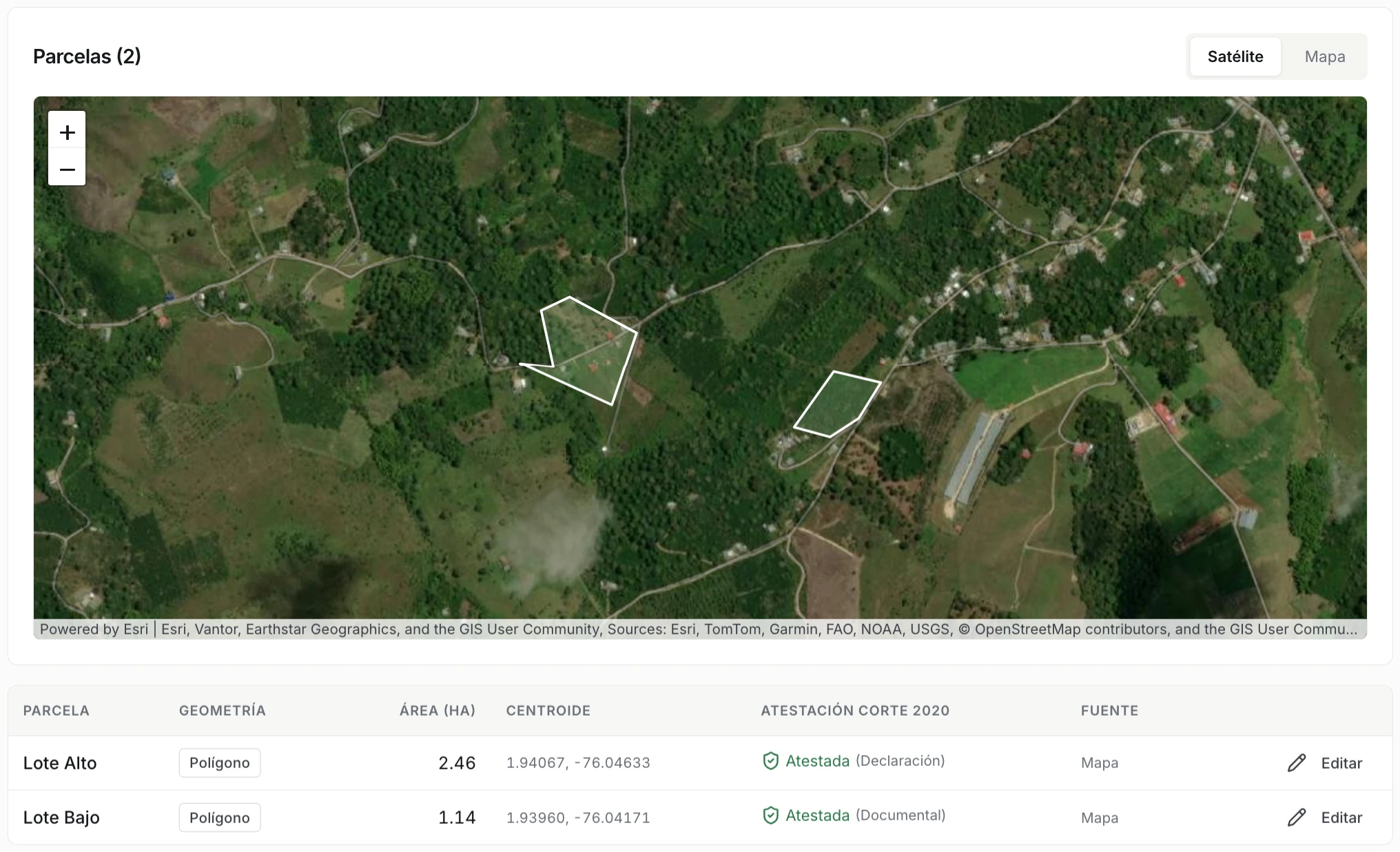
Download the GeoJSON and the DDS package (JSON) and hand them to your buyer. The system warns when the file nears the European system’s size limit.
It cannot be finalized with errors. Every accepted warning requires a written reason, recorded with who and when. A finalized dossier is never edited: if something changes, a new version is created that replaces it.
Producers’ names and ID numbers are left out of the download unless you turn them on.
BeanFlux does not file the DDS or connect to the European system: your buyer does that, with the dossier you hand over.
Cacao has no national registry that does part of the work: the producer record is built by whoever buys. See how it is built in the EUDR guide for cacao (in Spanish).
See the dossier of an order →The program
What early access includes
Exporters in the program get the complete operational platform, the quality for export module, and the shipments and documents module we are building with them. Every piece says where it stands: available today, or being built with the group.
Origin, purchasing and traceability
What an exporter already uses in BeanFlux, for coffee and for cacao.
EUDR dossier per order
GeoJSON and a DDS package for every export order, with a completeness check before it leaves. Your buyer files the DDS; you hand over the data, ready.
Farms and plots, once
Each farm and plot is registered once, with validated geometry, and every receipt is linked to its plot of origin from the first record. The system can require origin at receipt or warn when it is missing.
Traceability to the export order
Every receipt creates an immutable lot. Trace any green coffee lot backwards, to the receipt and the supplier of origin, and forwards, to the export order it was assigned to.
Private buying marketplace
Publish buying orders to your closed supplier network, receive organized, comparable quotes, and award with a complete history. No more closing deals over chats.
Coffee and cacao on one platform
The regulation covers both products. So does BeanFlux: each with its own flows, qualities and price references, without duplicating systems.
The complete operational platform
Purchases, inventory by lot, quality control, contracts and margins per operation. The export modules are not a separate system: they are part of the same flow.
Quality for export
You sell a specification, not a name. Supremo, EP and UGQ are preparations agreed with the client: a minimum screen, a tolerance, a defect cap, a moisture range and a cup. This module turns them into data on the lot.
Physical analysis on any lot
The same coffee is measured several times: after milling, before the sale, before shipment and on arrival. Each analysis stays on the lot with its purpose, its method and the sample size, and the history is in one place.
Preparations as specifications
You define your preparations once: Supremo, EP 10%, UGQ, or your own. Every analyzed lot shows which ones it meets and why, criterion by criterion. The limits are yours, dated, and every change is kept as a new version.
Screens and defects by group
The screen-size distribution of each analysis, with the percent over each screen already calculated. Defects are counted by group 1 and group 2, with their equivalence in full defects and the total.
Lot identity
Varieties, process, altitude range, municipality and crop year of each lot, derived from the farms behind it. Lines by producer group, and a "do not blend" mark for the microlot that is sold whole.
Cupping
From a cup check (clean cup, yes or no, and the defect) to a session with several cuppers on the SCA 100-point form, with descriptors. The score stays on the lot with its protocol.
Samples with the buyer’s approval
Every sample registered with its type (offer, pre-shipment, arrival, retained), its lot, its recipient and its tracking number. The buyer’s verdict is kept with its evidence.
Export: shipments and documents
The export contract, the packed lot, and every container with its steps before the FNC. BeanFlux keeps track of that chain; it does not file anything for you.
Export sale terms
The sale contract states the whole deal: preparation, packing, shipment period, weight basis, payment term, sample clause and destination. With its confirmation in Spanish and in English.
Margin on a dollar sale
Quantity in kilos, pounds or bags; price in cents per pound, dollars per kilo or per bag. With the rate locked on the contract or on the fixation, the margin of a dollar sale is calculated without mixing currencies. With no locked rate, none is invented.
Packing, liner and marks
A 70 kg fique sack, a GrainPro-type liner, bags per container. The export lot leaves with its mark: the lot number with your exporter code and its serial, and the contract’s bag-mark template, ready to print.
The shipment and the FNC chain
One screen per shipment: booking, shipping line, vessel, port, containers and seals. And every step with its number, date and supporting document: sale announcement (anuncio de venta), inspection (revisión), transit permit (guía de tránsito), reweighing (repeso), coffee contribution and certificate of origin.
Shipping documents
Packing list per lot, commercial invoice, shipping instructions and shipping advice to the buyer, generated from the data already in the system. The commercial invoice is not the DIAN electronic invoice.
Offer sheet for importers
A PDF per lot, or a list of available lots: preparation, screen, score and descriptors, varieties, process, altitude, region, crop year, packing and bags available.
Preparations and the FNC chain are for coffee. The EUDR dossier, purchasing and the marketplace cover coffee and cacao. BeanFlux records numbers, dates and supporting documents: it does not file with the Portal Cafetero, the DIAN or the European system, and it does not issue electronic invoices.
Stop closing purchases over chats and calls
Today a large buying order moves like this: calls, messages, prices going back and forth over WhatsApp, and in the end nobody has the complete history of who quoted what. BeanFlux’s private marketplace changes that flow: you publish your buying order once, with templates that get it ready in minutes, and it reaches your entire supplier network at the same time.
The network is yours and it is closed: you invite your trusted suppliers. Each supplier quotes without seeing anyone else’s numbers, and you see every quote in real time, compared side by side. When you close the quoting window, you award: to a single supplier or split across several. Every award is recorded in the system with its contract, its order and its internal document.
- Publish your buying order once, in minutes
- Your entire network receives it and quotes in parallel
- Compare every quote side by side, in real time
- Award in full or split; the contract is recorded
- Negotiations scattered across chats, calls and emails
- Quotes with no record and no history
- Suppliers finding out what everyone else is quoting
- Orders closed with no document and no traceability
Before you invite them
Your suppliers are not going to change on their own
In this business, almost nobody changes systems out of conviction. They change because someone asks them to as a condition of continuing to buy from them, or because they already felt the cost of not doing it. As an exporter, you are one of the few parts of the chain with that leverage: you decide who you keep buying from.
Ask for the format, not the favor
For coffee, most of the origin data is already covered by the FNC’s SICA registry; cacao has no equivalent. What is missing in both is specification and volume: it is enough to decide the format in which you expect to receive those two per lot, and how often, without having to convince anyone that a system is a good idea.
Start with the marketplace
When you invite your supplier network to quote on your private marketplace, you are already moving them toward a structured record, without asking them to adopt anything on their own.
Less reconciliation on your side
Every supplier who organizes their information before sending it gives you back the time you spend today cross-checking it against your own records, shipment by shipment.
To know exactly what to ask them, and why most do not deliver it on time, see our guide: what an exporter really needs from its suppliers (in Spanish).
Frequently asked questions
What exporters ask us
What exactly does the EU Deforestation Regulation (EUDR) require?
The EUDR requires that every lot of coffee or cacao entering the European Union is backed by the geolocation of the farms that produced it, evidence that those lands were not deforested after 2020, and a due diligence statement (DDS) filed before entry. For the Colombian exporter, the operational part is traceability: knowing which farm every kilo of an order came from, and being able to prove it.
What does the EUDR dossier BeanFlux builds include?
One dossier per export order. It gathers the plots of every allocated lot, downloadable as GeoJSON, and a DDS package in JSON with what your buyer needs to file its declaration: operator, buyer and their country, tariff code, net kilos, plots and producers. Before it leaves, the system checks that every lot traces back to a receipt with origin, that geometries are valid and that kilos are consistent, and tells you what is missing. Once finalized, it is immutable.
When does the EUDR take effect?
The regulation is already in force; what arrives now is mandatory application: December 30, 2026 for medium and large operators, and June 30, 2027 for micro and small companies. Those dates apply to the operator in the European Union (your buyer), not to you. For a Colombian exporter the real date comes earlier: expect your European buyers to ask for geolocation and due diligence information before then, to secure their own supply chains.
Does BeanFlux connect directly to the European Union system?
No. BeanFlux originates and organizes the data and builds the dossier for every order, but it does not file the DDS. The operator that places the product on the European Union market files it, normally your buyer, with the dossier you hand over. If you have a subsidiary or a representative in the EU that files on your behalf, the same dossier works for them.
Is the marketplace open? Who sees my buying orders?
It is not open. It is your private network: you decide which suppliers join, and only they receive your buying orders. Each supplier sees only their own quote, never anyone else’s. You, on the other hand, see all of them in real time, compared side by side. It is a negotiating desk with your trusted suppliers, not a public auction.
What happens when I award a buying order?
The award can be full or split across several suppliers. When you award, the system generates the operation records for both sides, contract and order included, and produces the internal purchase order document. The deal is closed with a complete history: who quoted, when and under what terms.
Does the program cover cacao too?
Yes. The European regulation covers coffee and cacao, and BeanFlux manages both on the same platform, each with its own qualities, flows and price references. If your operation exports both, you do not need two systems.
Is BeanFlux software or an ERP for coffee exporters?
BeanFlux is the exporter’s operational platform: purchasing, quality, inventory by lot, milling, contracts, margins, and the EUDR dossier for every order. It is not an ERP and does not replace one: accounting and electronic invoicing stay in the system you already have. BeanFlux integrates with your ERP and your accounting system to import and export the data your operation needs. Which data and in what format is defined with you during implementation.
What commitment does joining the program involve?
Using the system in your real operation and telling us what works and what is missing, in short feedback sessions. Implementation is guided: we migrate your data, configure your qualities and warehouses, and train your team. No technical staff required.
When will the export modules be ready?
The operational platform (purchases, inventory, quality, contracts, margins), the EUDR dossier per order and the private marketplace are available today. So is the Quality for export module: physical analysis on any lot, preparations, lot identity, cupping and samples. The Export module (shipments and documents) is delivered in stages to the exporters in the group. The state of each piece is on this page, under "What early access includes". Joining early means your operation defines what gets refined first.
Does BeanFlux handle preparations such as Supremo, EP and UGQ?
Yes, as specifications and not as labels. You define each preparation with its minimum screen, its tolerance, its defect caps and its moisture range, and BeanFlux tells you which lots meet it and why. The values are yours and editable, because those preparations are agreed with each client.
Does it record cupping and pre-shipment samples?
Yes. Cupping goes from a cup check to a session with several cuppers on the 100-point form, and the result stays on the lot. Every sample is registered with its type, its shipping and the buyer’s verdict.
Does BeanFlux handle the export procedures with the FNC or the DIAN?
It does not file them: it keeps track of them. For every shipment it records the number, date and supporting document of each step (sale announcement, inspection, transit permit, reweighing, coffee contribution, certificate of origin) and shows what is missing. The procedures are still done in the Portal Cafetero and with the DIAN. Today it is being built with the exporters in the early access group.
Can I ask my suppliers to register their operation in a system like BeanFlux?
Yes. For coffee, origin is usually already covered in large part by the FNC’s SICA registry; cacao has no national equivalent. What is missing in both cases is specification and volume. It does not depend on convincing your supplier that software is a good idea, only on deciding the format in which you expect to receive those two per lot, and making that a condition of continuing to buy from them. The private marketplace is already a first step in that direction: the moment you invite your network to quote there, you start receiving structured information, without asking anyone to change systems on their own.
We build these modules with exporters, not for them
BeanFlux was built from inside the business, with people who have spent decades buying, milling and exporting. The export modules follow the same path: a limited group of exporters uses them on their real operation, and what is missing gets built in that order, not in the one we imagine.
- Guided implementation from day one
- The export modules at no additional cost during the program
- Direct priority over the export roadmap
- Your data is yours, exportable at any time
- Coffee or cacao exporters operating in Colombia
- Current or planned sales to European Union buyers
- Willingness to use the system in daily operations
- Short feedback sessions with our team
Request early access
If you export coffee or cacao from Colombia and the EUDR is on your radar, let’s talk. We show you the dossier of a finished order and the marketplace in 30 minutes and explain how the program works. Slots are limited because every exporter in the group gets direct, hands-on support.
Request early access →30 minutes · No sales presentations · Response within 24 hours